
Case study · TripWays · 2026
MCP: Putting a travel marketplace inside ChatGPT and Claude
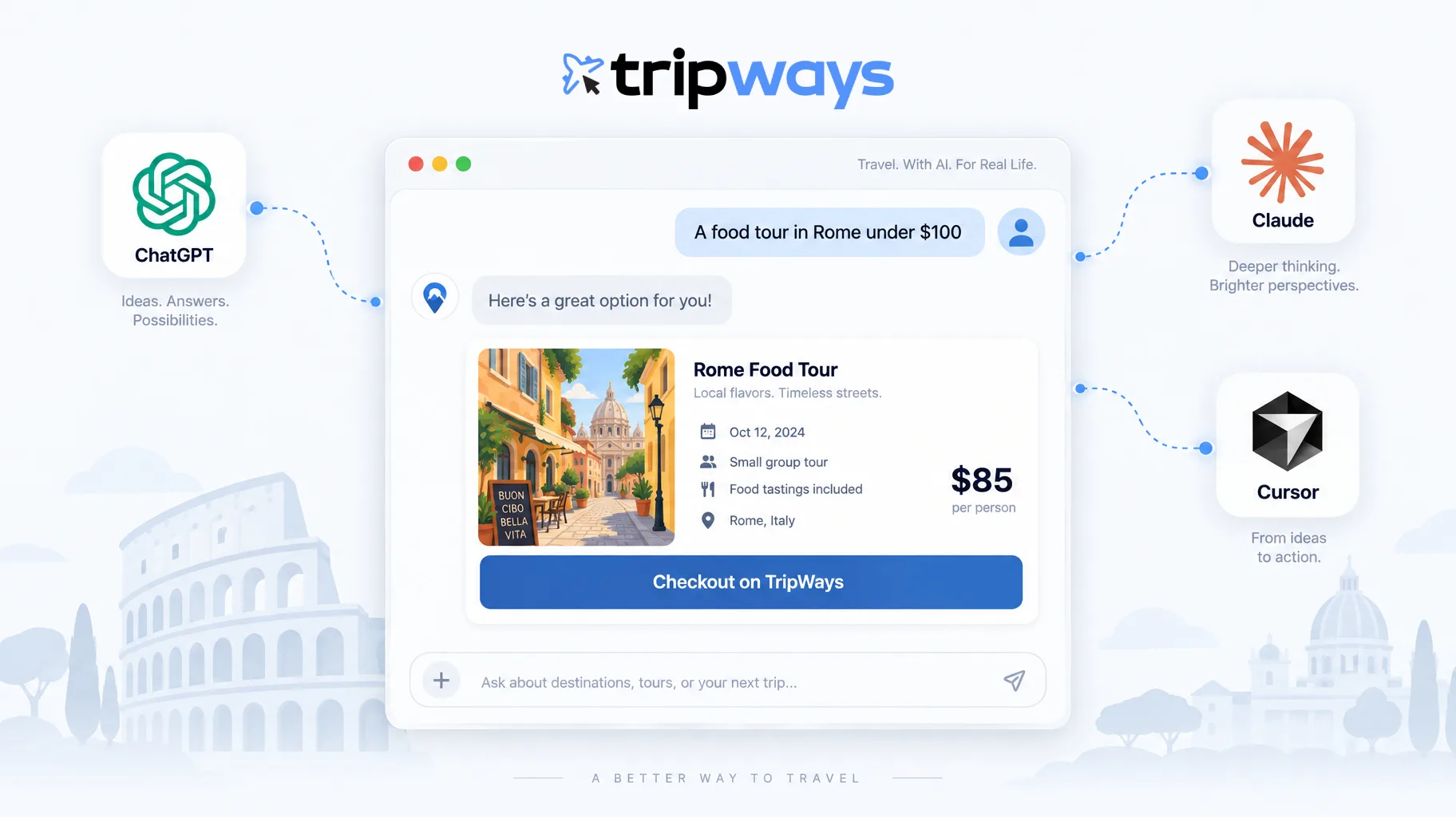
Travelers have started asking AI assistants where to go. I built a public MCP server so ChatGPT, Claude and other assistants can search TripWays’ live catalog, check dates, quote a real price and hand the traveler a prefilled checkout on tripways.com. It went from first commit to Claude’s connector directory in three weeks, and it brought TripWays links and mentions across the AI and marketing world.
- Co-Founder & Head of Growth
- TripWays · MCP server and AI distribution
- Sep 2026 – Present
November 2026. Try it at tripways.com/mcp.
The bet
Travel questions are moving into AI assistants
People now plan trips by asking ChatGPT or Claude. An assistant can only recommend what it can reach, and a marketplace it can’t reach isn’t in the answer.
In 2026 that door was open and almost empty. So I made TripWays a catalog an assistant can actually use: real tours, live prices and a link to book.
The rules
What it had to be
- Free, with no login or API key.
- Read-only: it can’t charge a card, hold a seat or ask for personal details.
- Live: dates, seats and prices from the operator’s calendar at the moment of asking.
- First-party: the traveler books and pays on tripways.com.
The system
From a question in a chat to a checkout on our site
The server is a thin, safe layer at the edge. Everything that matters stays in TripWays’ own systems.
01 · Ask
A traveler asks an assistant
- ChatGPT, Claude, Cursor or Gemini
- In plain words, in any languageAI
- The assistant picks the right toolAI
02 · Edge
A small server at the edge
- Fair-use limits and caching
- Holds no payment, booking or AI keys
- Logs tools and outcomes, never chat text
03 · Catalog
TripWays answers
- The same AI search as the siteAI
- Live dates, seats and totals
- Internal fields stripped from every answer
04 · Book
The traveler books with us
- A checkout with date, group and option filled in
- Payment on tripways.com
- Every visit tagged by assistant
Every call is logged by tool and outcome, so what travelers miss becomes the next fix or the next tool.
What I built
How the server was built and launched
Tool design
Twelve tools an assistant can use well
It launched in September 2026 with six tools: the shortest path from a question to a checkout. Search, tour details, which city you mean, open dates, a price for your group, and the booking link.
In October I added six more for what travelers asked next: compare tours, reviews, cancellation terms, the meeting point, alternatives when a date is full, and day-by-day trip ideas. Every answer is written for the traveler. When a city name could mean two places, the server asks which one instead of failing.
- 6 → 12
- tools in the first five weeks
Security and privacy
Safe by design, not by promise
Every tool is read-only. The server can’t charge a card, hold a seat, start a cart or ask for a name or email. The edge server holds no keys to bookings, payments or AI models: it only talks to TripWays, which decides what’s shared and strips internal fields from every answer, with a test on each change.
It stores no IP addresses and no chat text. Limits per caller and overall keep one busy client from slowing the site, and the whole channel has an off switch.
Distribution
Listed where assistants and developers look
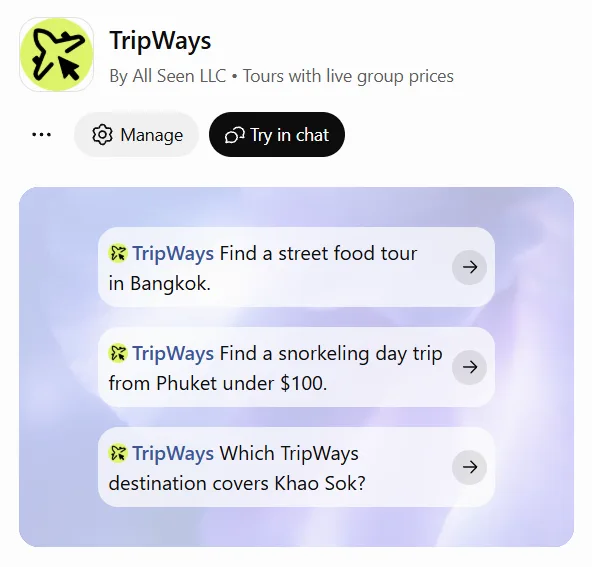
TripWays is in the official MCP Registry, Claude’s connector directory, ChatGPT and Glama, where it’s graded A. One-click setup covers Cursor, Gemini CLI and Claude Code, from a public GitHub repo.
Each review taught something. Claude’s directory counted “no tours found” as an error, which read as a 22% error rate, so I changed how outcomes are reported: no match is an answer, not a failure. OpenAI asked for tools that read a live calendar to say so. And ChatGPT’s age rules meant adults-only experiences left the results.
- 3 weeks
- from first commit to Claude’s directory
First-party checkout
The assistant finds it. The booking stays ours.
A quote is a price, not a hold. When the traveler is ready, the booking link opens checkout on tripways.com with the date, time, group and option already filled in, and the price is the same one the site shows.
Every link is tagged with the assistant it came from, so AI assistants are measured like any other channel: visits, carts and bookings, side by side with Google and email.
Marketing results
A new channel, and the links and mentions that came with it
The listings put TripWays in front of people where AI tools are discovered: directories, registries, developer lists and write-ups about MCP servers. Many of them link back and mention TripWays by name.
In about two months after launch, the number of sites linking to tripways.com doubled, from about 1,400 to 2,800. For a marketplace, that’s search authority no ad budget buys, and visibility across the whole AI and marketing tools world.
- 2×
- sites linking to tripways.com, about 1,400 → 2,800
How I ran it
Ship small, get listed, watch, fix
A new channel rewards speed. The loop below took TripWays from an idea to every major assistant in weeks.
- 01ShipThe smallest set of tools that gets a traveler from a question to a checkout.
- 02ListThe official registry and each assistant’s directory, meeting their review rules.
- 03WatchEvery call logged by tool and outcome, with no personal data.
- 04FixWhat travelers miss becomes the next fix or the next tool.
What I bring
What this means for your team
Any company with a catalog, a price list or a booking flow can be answerable inside AI assistants.
AI distribution strategy
I find where your customers are asking AI, and get your product into the answer: MCP, ChatGPT apps, directories and registries.
Tools AI can use
I design the tools and answers so assistants pick the right one, explain it well, and send people to your checkout.
Safe by default
Read-only tools, no keys at the edge, no personal data kept, and limits that protect your site.
Platform reviews
I take a product through Anthropic’s and OpenAI’s reviews and turn their feedback into a better product.
Questions
What is an MCP server?
MCP (Model Context Protocol) is the standard way AI assistants such as ChatGPT and Claude connect to outside tools. With the TripWays server, an assistant can search the live catalog and quote a real price instead of guessing.
Can an assistant book or charge through it?
No. Every tool is read-only. The assistant hands the traveler a checkout link, and the traveler books and pays on tripways.com.
What does TripWays receive from a chat?
Only what the assistant sends to a tool: a place, dates, a group size. No name, email or location is asked for, and the server keeps no chat text or IP addresses.
How does it find tours?
With the same AI search that runs the TripWays site and WhatsApp concierge. The AI search case study explains how it works.
How do I try it?
Add TripWays from Claude’s connector directory or ChatGPT, or add https://mcp.tripways.com in any MCP app. Setup is on tripways.com/mcp.
Want a growth system like this on your team?
I’m open to growth leadership roles, and I run fixed-price AI growth sprints for companies in any industry.