
Case study · TripWays · 2023–2026
A travel marketplace with 16,000 tours, run by a solo-builder, and AI agents
TripWays is a travel marketplace I co-founded: tour operators list once, and travelers find them on Google, on our site, on WhatsApp and inside AI assistants. I led growth and built the system behind it. Rules and AI agents prepare every tour, only the ones that pass get promoted, and one warehouse shows what to fix next.
- Co-Founder & Head of Growth
- TripWays · B2B2C travel marketplace
- Dec 2023 – Present
Public figures, October 2026. More on my CV.
The system
One catalog, prepared once, sold everywhere
Most marketplaces add a team for each new channel. I built one pipeline instead: every tour is checked and prepared once, then goes to every place travelers look.
01 · Supply
Tour operators join
- Hundreds of operators in 120+ countries
- Self-serve onboarding in the Partner Hub
- Live prices and seats from their booking system
02 · Prepare
Every tour made ready
- Rules check what can be sold
- Titles, itineraries and translationsAI
- Each tour matched to real placesAI
- Questions to operators, approved by a personAI
03 · Distribute
Wherever travelers look
- Google Things to Do on Search and Maps
- Tour, destination and attraction pages
- Concierge on the site and WhatsAppAI
- Inside ChatGPT and ClaudeAI
04 · Measure
One view from visit to booking
- Every channel tracked to the booking
- One warehouse, one definition per number
- Questions to the data in plain EnglishAI
What the data shows becomes the next fix list for the Prepare stage.
My role
Head of Growth, and the builder behind it
I co-founded TripWays and led growth. A team of up to ten built it with me through the launch years. Today a core team of three runs it, with AI agents doing the repetitive work.
- Tour operators
- Vendor operations
- Editorial
- Engineering
One marketplace plan
Which tours to promote, where, and what to fix next.
- Support
- Paid media
- Data Pipelines
- AI agents
How I run growth
Prepare, promote, measure, decide
With 16,000 tours and a small budget, the hard question is what deserves promotion. The same loop answers it every week.
- 01PrepareRules and AI agents get each tour ready: true facts, clear titles, real places, good photos.
- 02PromoteGoogle listings, small campaigns by destination, and AI assistants that quote live prices.
- 03MeasureEvery visit is followed to the booking, by channel, in one warehouse.
- 04DecideA person turns the findings into the next fix list, and changes what gets promoted.
Choosing what to promote
Only the best-prepared tours get promoted
A big catalog is only worth something if travelers trust what they find. So nothing is promoted until it passes the same checks.
Every tour goes through one set of checks before it’s promoted anywhere: on Google, in ads or through AI assistants. Most are rules in code. AI helps where judgment is needed, and a person decides anything uncertain.
The checks run on a schedule, so a tour whose price or dates change drops out on its own, and comes back once it’s fixed. Only a small share of the catalog makes it through, and that’s the point.
- Every tour operators list
The full catalog
- Trusted operators
Operators we vouch for
- Sellable tour types
Nothing restricted
- Bookable now
Open dates, confirmed at once
- Matched to real placesAI-assisted
Each place named on the tour’s own page
- Photos and prices checked
The shown price is the booking price
- PromotedA person checks
Anything uncertain waits for a person
What I built
Six pieces of one growth system
B2B and vendor onboarding
Operators onboard themselves, in under 30 minutes
Signing an operator used to take days of staff time: contracts, checklists, payout setup and rewriting their listings. I turned it into a self-serve flow in the Partner Hub. Operators accept the current terms, the checklist fills itself, and payouts are set up in the same place.
AI agents then prepare their tours. When a gap only the operator can fill, such as whether an entrance ticket is included, the system drafts the question. Nothing is sent until a person approves it.
- <30 min
- to onboard an operator, down from days
AI agents and evaluation
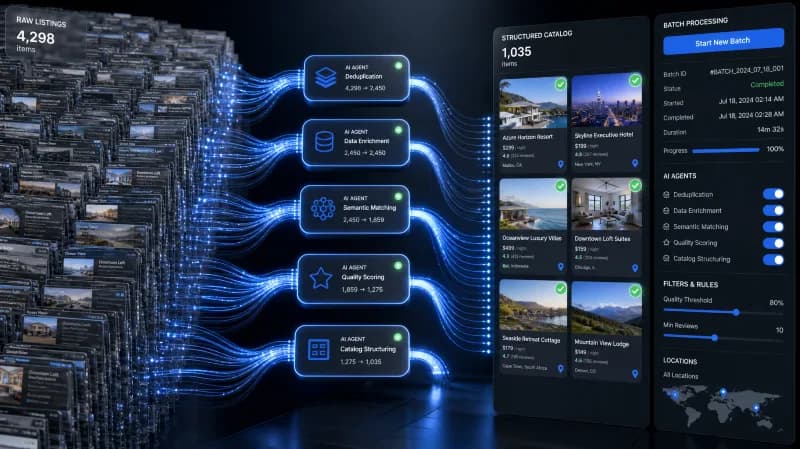
AI agents prepare 16,000 listings, with rules around them
Supplier listings arrive in every style and quality. Scheduled agents standardize them: clear titles, itineraries, tags, translations, tour types and the real places each tour visits. Each agent has an off switch, a time budget and a batch size.
The rule I hold to is rules first, AI where judgment is needed. A place counts only if the tour’s own page names it. The concierge must pass scripted test conversations before any change goes live.
AI distribution
The catalog inside ChatGPT, Claude and WhatsApp
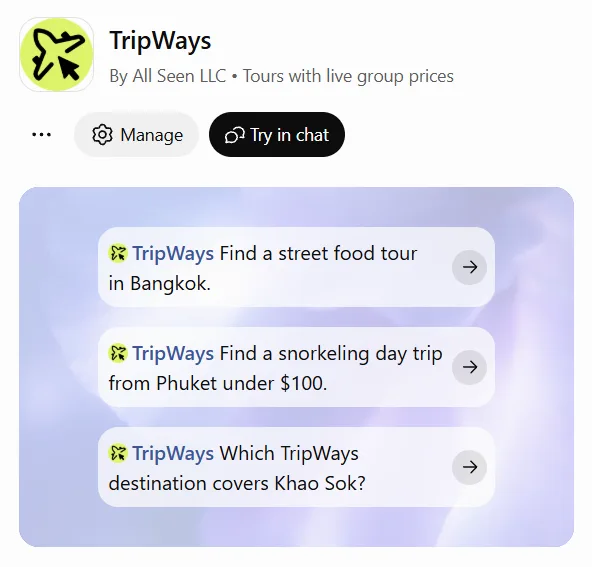
Travelers now ask AI assistants where to go. I made TripWays answerable there: a public MCP server, listed in the official MCP Registry and Claude’s connector directory, lets any assistant search tours, check live availability, quote a price and hand over a booking link.
The same brain runs a concierge on our site and on WhatsApp. The model never owns the facts: prices, dates and seats come from the live booking system, the traveler always pays on tripways.com, and a person can take over any chat.
SEO and AEO
Pages that search engines and AI answers can quote
Every tour, destination and attraction has a page built from the same catalog, with an introduction, questions and answers, and structured data that tells Google and AI assistants exactly what it describes. Attraction pages group every tour that visits a place, at a clean address by country and city.
For AI answer engines, the site publishes a plain guide to what TripWays offers and how assistants can connect to it, and it keeps AI crawlers off pages that only cost money to serve.
Video and content
A travel channel that feeds the marketplace
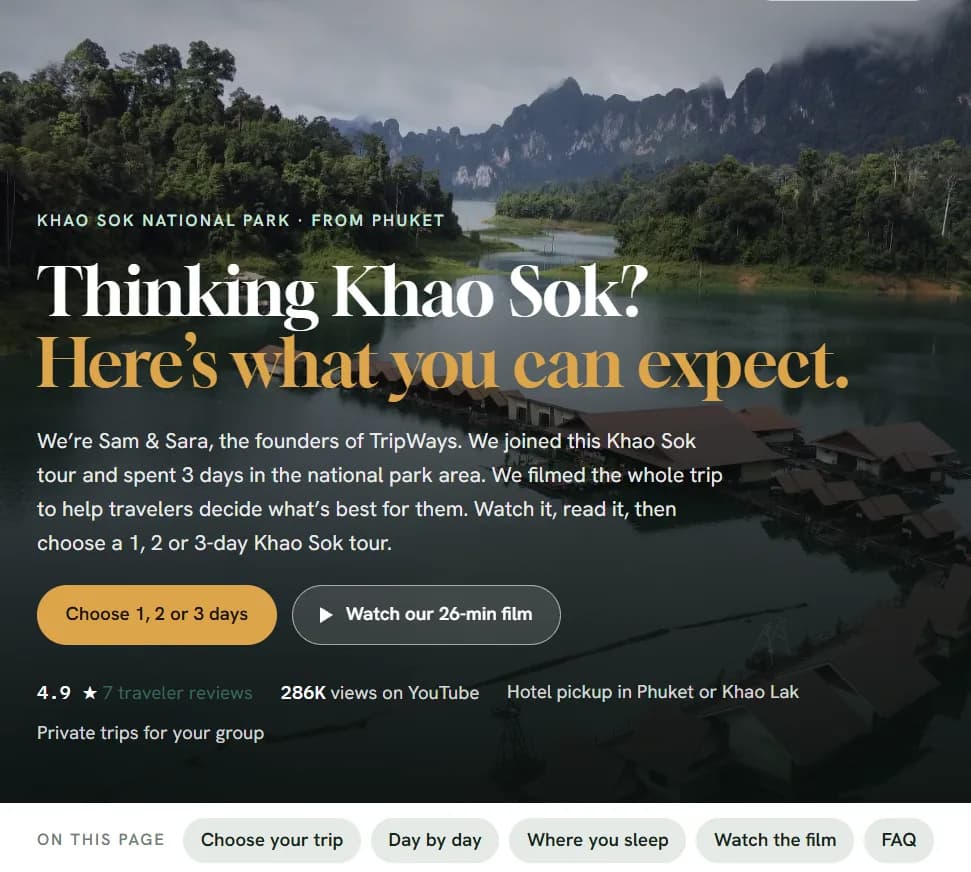
I write, film, host and edit TripWays’ YouTube channel: real tours with the operators who run them, from Khao Sok to Bali’s reefs. Each video points travelers to tours they can book, and the footage feeds our pages and ads.
- 32K
- subscribers
- 943K
- views



Measurement
One warehouse, from first visit to booking
I built the measurement stack: Google Analytics and Tag Manager on the site, a server-side purchase event, and a BigQuery warehouse loaded every night through n8n. Each number has one definition, and a late or failed load posts an alert instead of failing quietly.
I ask the warehouse questions in plain English through Claude. It once surfaced a tracking event that had gone missing after a checkout change; we fixed it, and the data confirmed the fix. The same view guided where to invest.
What I bring
What this means for your team
The same approach fits any marketplace or travel company with a large catalog and more channels than people.
Growth systems, not campaigns
I build the pipeline that decides what to promote and where, so growth doesn’t depend on a person doing it by hand.
AI that’s safe to run
I put AI agents to work where judgment is needed, with rules, tests and a person on money and outside contact.
Supply and partnerships
I onboard and manage hundreds of suppliers with self-serve tools, and meet platforms like Google on their own standards.
Distribution where demand is moving
Google, search and AI answers, WhatsApp and AI assistants: one catalog, every door, measured the same way.
Questions
What is Google Things to Do?
Google’s listings for tours and activities on Search and Maps. Approved partners send a product feed, and their tours appear with a booking link to the partner’s own site.
What is an MCP server, and why does a marketplace need one?
MCP (Model Context Protocol) is the standard way AI assistants such as ChatGPT and Claude connect to outside tools. With one, an assistant can search TripWays’ live catalog and quote a real price instead of guessing. You can try it yourself.
How much of TripWays runs on AI?
Preparing listings, answering travelers and reading the data. Rules decide what can be sold and at what price. Anything that spends money or writes to an operator waits for a person’s approval.
Did you write the code yourself?
I build with AI coding tools. I decide what to build and own the architecture, the review and the release; the AI writes much of the code. Through the build, a team of up to ten worked with me, engineers included.
Want a growth system like this on your team?
I’m open to growth leadership roles, and I run fixed-price AI growth sprints for companies in any industry.